
|
|
||
|
19 SEPTEMBER 2025. 7:30 p.m. FOURTH CARPATHIAN BASIN CLASSICAL MUSIC FESTIVAL – MEETING ABBE LISZT OLD ACADEMY OF MUSIC CHAMBER HALL Concert of sacred works by Ferenc Liszt The Liszt concert of the Fourth Carpathian Basin Classical Music Festival follows the lectures on music history, roundtable discussion and museum tour starting that afternoon at 4:00 p.m., and crowns this rich event. The audience can hear masterpieces from Liszt’s sacred oeuvre. The programme includes songs with piano accompaniment, solo and four-hand piano works. At the concert, Katalin Szutrély will sing, Peter Caelen, Andrea Várnagy and Apolka Bonnyai will play the piano, and one of the most distinguished experts on Liszt's oeuvre, music historian Mária Eckhardt, winner of the Széchenyi Prize, will acquaint the audience with the works. Programme: Via Crucis – excerpts S. 583 Stabat Mater S. 172b Gebet S. 331 From the Cradle to the Grave S. 598 The concert is introduced by: Mária Eckhardt Via Crucis – The 14 Stations of the Cross, four-hand piano version, S. 583 – excerpts: Introduction (Vexilla regis, Ave Crux) – Station I: Jesus is condemned to death – Station IV: Jesus meets his Holy Mother – Station XI: Jesus is crucified – Station XII: Jesus dies on the Cross – Station XIV: Jesus is laid in the tomb Stabat Mater, S. 172b The Gregorian hymn "Stabat Mater dolorosa" (The Mother stood grieving) has been adapted by numerous composers and is still part of today's liturgy (it is sung at the Colosseum during the Good Friday Way of the Cross). It also plays an important role in Liszt's Via Crucis, but its most ambitious adaptation for soloists, choir, and large orchestra is the 12th movement of the Christus oratorio. The short Stabat Mater piano piece preserved in the National Széchényi Library was previously considered a paraphrase of the "Stabat Mater" in Christus. However, apart from the identity of the Gregorian hymn, the piano piece has no connection with the oratorio, but the other musical material that Liszt uses in it is taken from the "Cujus animam" movement of Rossini's Stabat Mater oratorio, thus creating an independent paraphrase, which was first published in the New Liszt Complete Edition in 1978. Hymne de l’enfant à son réveil / Hymn of the Child Upon Awakening – Harmonies poétiques et religieuses / Poetic and Religious Harmonies No. 6, S. 173/6 The work was originally a vocal piece composed by Liszt for his three children, Blandine, Cosima, and Daniel, based on a text by Alphonse de Lamartine. The first version was written in the mid-1840s, but after numerous revisions, the final version was not published until 1875 for female choir and piano, with harp ad libitum. However, the piano version had already been published earlier, in 1853, as No. 6 in the cycle Poetic and Religious Harmonies. La Notte / The Night, S. 516a The origins of La Notte date back to the second piece, "Il Penseroso" ("The Thinker"), in the second volume of Années de Pèlerinage / Years of Pilgrimage II, Italy, which Liszt composed inspired by Michelangelo's statue in the Medici Chapel in Florence. When Liszt published this piece, he printed not only Michelangelo's statue on the title page, but also the sculptor's sombre poem entitled "La Notte": ”Night in so sweet an attitude beheld / Asleep, was by an angel sculptured / In this stone; and sleeping, is alive; / Waken her, doubter; she will speak to thee.” Between 1860 and 1864, after the loss of Daniel and Blandine, he composed La Notte, the second piece of his Three Funeral Odes for orchestra with versions for violin and piano and solo piano, based on the music of "Il Penseroso." He also printed Michelangelo's quoted poem before this work, and in the middle section, above the Sempre lento section reminiscent of the Hungarian verbunkos, he also printed a quote from Virgil, which refers to how sweet it is to remember one's beloved homeland as death approaches. The piano version of La Notte was only published in 1976 in the New Liszt Complete Edition. Due to the subtitle “October 1849”, it was long thought that Liszt was commemorating Chopin’s death in this work, which is also suggested by the fact that the martial march section of the work with its ostinato bass triplets is reminiscent of Chopin’s Op. 53 Polonaise in A-flat. However, in an early manuscript, the subtitle was "Magyar," so Funérailles primarily commemorates the martyrs of the war of independence, while also expressing the shared desire for freedom of the Polish and Hungarian peoples. Gebet / Prayer, S. 331 The lyrics of the song, composed in 1878, were written by Friedrich von Bodenstedt, based on Lermontov: "If I am overcome by despondency / if grief strikes me to the ground, / one blessing remains as consolation, / the sweet, fervent prayer. /// The verse is sacred, for it contains / the sublime heavenly word. / The sinful heart repents, / finds peace, and is good again. /// No longer tormented by doubt, / which once dragged it down. / Ready for new tears, ready for new faith, / it flies like the air, the air.” The song begins with the motif of the Cross, and Liszt's meditative music, which explores numerous keys, faithfully follows the mood and every vibration of the text. Jeanne d’Arc au bûcher / Joan of Arc at the Stake, S. 293 According to its subtitle, the work is a dramatic scene based on a poem by Alexandre Dumas père, the first version of which Liszt composed and published in 1845 for voice and piano. The poem is the prayer of the unjustly condemned virgin heroine, who, before stepping onto the pyre, recounts her entire life. Although she fears death by burning, she is proud to have fulfilled the lofty task she undertook at the heavenly suggestion. In Dumas's three-verse poem, the refrain gives special emphasis to this contrast, which Liszt's musical arrangement further highlights: "I am going to the stake, / And yet, I've saved France.” Liszt revised this work several times; in one version, he arranged the piano part so that it could be performed on the dual instrument on display at the Franz Liszt Memorial Museum, an Erard-Alexandre piano-harmonium. The artists perform the version published in 1876, which is actually the piano reduction of the orchestrated dramatic scene. Artistic director of the festival: Apolka Bonnyai Participation in the concert is free, but registration is required. |
||
Performers |
||
| Andrea VÁRNAGY | ||
|
Her mission as a pianist is to make an ever wider public for classical music. Thus the Music Imagination programme started with her participation in 2004, then in 2018 she initiated the Magical Music Movement, through which children can turn their attention to the values and beauties inherent in music. In this work she is making use of other genres of art as well. This movement so far has reached almost one a half million children within and outside Hungary, including several places where children never before had the chance to experience live classical music. Since 2018 Andrea Várnagy has regularly given four-hand piano concerts with her daughter, Lili Farkas, a classical piano student at the Academy of Music. Their unique mother-daughter .duo creates an atmosphere of intimacy among the audience, providing true inspiration for the children listening to them. Andrea Várnagy has built close connections with Subcarpathia through her concerts, and this region still has a special place in her heart. Since 2011 she has been giving regular concerts, organized music camps and courses, and supported the musical life in this region severed from Hungary. Since 2018 she has had a permanent link with Franciscan friar, Csaba Böjte,. and has joined in the musical life of Transylvania as well. She places great emphasis on developing talent. She developed her own unique method that she employs in her piano courses and which is also available online. Andrea’s repertory prominently features Franz Liszt’s pieces for piano four-hand. Andrea Várnagy is considered an outstanding piano four-hand player. Her musical activity has been recognized with the Budapest Brand Award and the Pro Familiis Award. In 2020 she was awarded the Liszt Prize. |
||
| Apolka BONNYAI pianist, Artistic Director |
||
|
She has won numerous scholarships and international music competitions. As a winner of the Grand Prize Virtuoso and the Golden Classical Music Awards international music competitions, she has performed at the Mozarteum in Salzburg and Carnegie Hall in New York. Winner of the Weingarten Fellowship, she studied at the Birmingham Conservatoire with Professor Malcolm Bilson, and then at Montclair University in the United States under David Witten and Mark Pakman, with the Terplan Research Fellowship. She performed with great success at the 9th Kyoto International Music Festival in Japan, which was recorded on CD. Other festival invitations include the Yamaha Artist Liszt Festival and the Hungarian Arts and Humanities Festival in New York, as well as the Cziffra Piano Festival. She has participated twice in the V4 Piano Festival in Sárospatak, where she was also artistic director in 2019. She has performed as a soloist in prestigious venues such as the Palace of Arts, Carnegie Hall, the Kennedy Center, Wiener Konzerthaus, the Mozarteum, the Alti Hall and many other concert halls in Europe and America. She regularly makes recordings in the Márványterem of the Hungarian Radio. Since 2001, Apolka Bonnyai has been a piano teacher at the Szent István Király Music Secondary School. She is the founder and artistic director of the Carpathian Basin Classical Music Festival. |
||
| Peter CAELEN pianist |
||
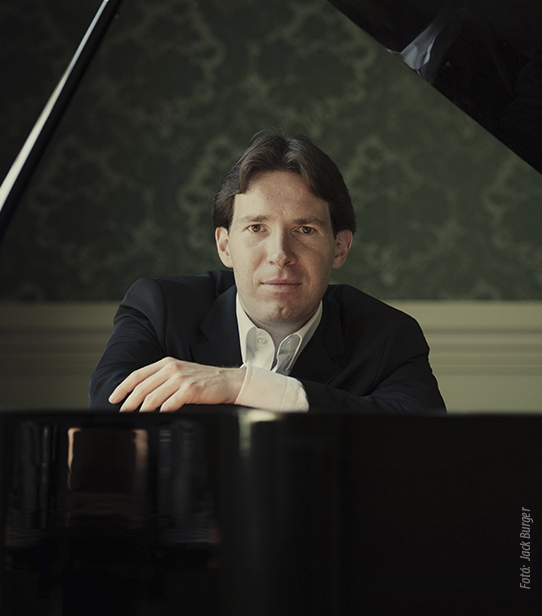 Peter Caelen began his studies at the Conservatories of Maastricht and Amsterdam with Frans van Beveren, Joop Celis, and Willem Brons, continuing in London with Peter Feuchtwanger and in Saarbrücken with Thomas Duis. He also attended masterclasses with renowned musicians such as Peter Donohoe, Lazar Berman, Eugen Indjic, Piotr Paleczny, and Jan Michiels. His competition achievements include first prize at the Prinses Christina Concours in Den Bosch, finalist at the International Johannes Brahms Competition, and a prize at the Ibla Grand Prize in Italy. In 2005, the Muziekgebouw Frits Philips in Eindhoven invited him to present his own concert series as part of the “Zuiderlicht” program. Peter Caelen has performed in prestigious venues across Europe, including the Concertgebouw in Amsterdam, De Doelen in Rotterdam, the Rhein Mosel Halle in Koblenz, the Great Hall of the Royal Conservatory in Brussels, and Holywell Music Room in Oxford. In recent years, he has expanded his activity in Asia, giving concerts in over 30 Chinese cities, including Beijing, Shanghai, Shenzhen, and Qingdao, and in 2022 he performed and led masterclasses in Jakarta, Medan, and Semarang, Indonesia. He is a regular guest at international festivals, including Klevischer Klaviersommer (Germany), Kamarihelmi Festival (Finland), Spectrum Festival (Slovenia), Alba Music Festival (Italy), Krakow Musical Autumn (Poland), and Klassz a Parton (Hungary). As a chamber musician, he frequently performs in a duo with cellist Olsi Leka, and collaborates with numerous other distinguished artists. His performances are also featured on recordings and radio broadcasts. Since 2006, Peter Caelen has served as the artistic director of the internationally renowned Excellent Concerts series and as programmer of the Muziek Klassiek Gulpen series. |


Sponsor: |
 |
|
karpatfesztival@karpatfesztival.hu
|
| karpatfesztival.hu© Minden jog fenntartva |
© 2026 karpatfesztival